At a glance
The story at a glance
- A wall charger is a small exercise in power, heat and space.
- Portable batteries have to balance capacity with the reality of carrying them.
- Magnetic wireless charging changes the simple gesture of putting a phone down.
- A cable's length and texture shape the feel of a daily setup.
- Anker's restrained forms are designed to live among ordinary objects.
The small things that keep a day moving
The most useful object on a desk is often the one with the least to say for itself. A charger sits near the edge, its cable curving toward a laptop; a portable battery waits in a bag beside a notebook and a pair of headphones. Neither is especially glamorous. Both become conspicuous when they are missing.
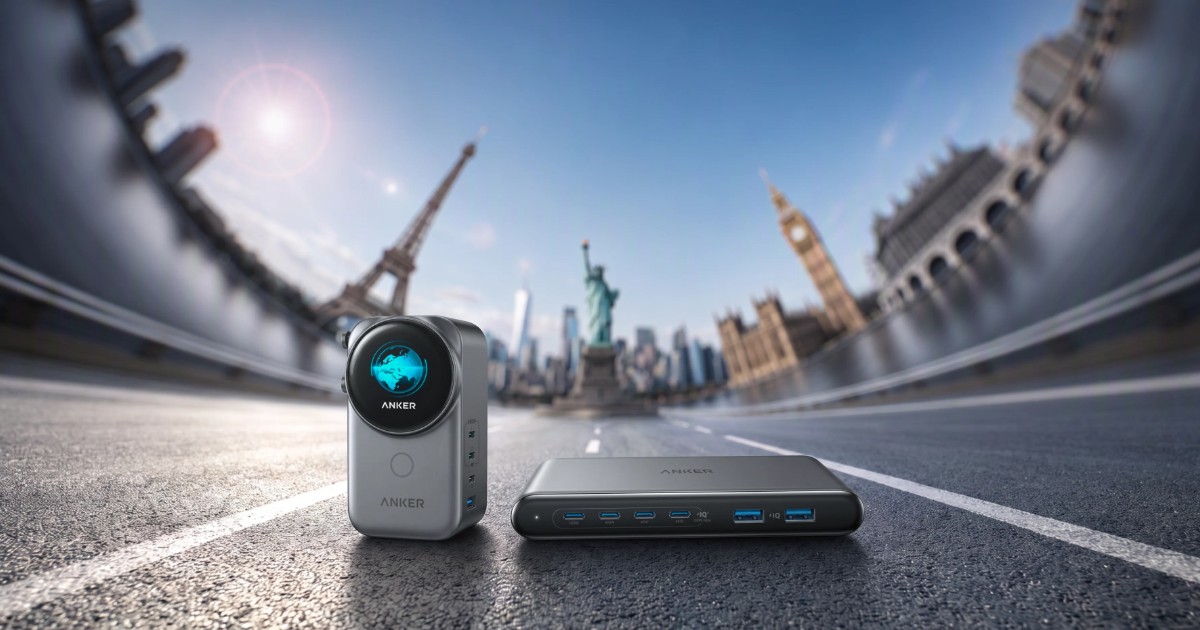
Anker has built much of its product world around this quiet territory: wall chargers, power banks, cables, wireless charging accessories and car chargers. These are objects for the spaces between more celebrated devices. They live in the socket behind a nightstand, in the pocket of a backpack, and on the corner of a kitchen counter where a phone lands at the end of the day.
That makes them interesting to look at closely. A charger has to negotiate a surprisingly intimate set of demands: it should be small enough to carry, substantial enough to feel dependable and simple enough to use without a second thought. A portable battery must balance the appeal of more stored power against the reality of its weight. A cable needs to bend, travel and survive being wound up in a hurry.
Anker’s approach is practical rather than ornamental. Its products tend toward compact shapes, rounded edges and restrained finishes, with the occasional display or foldable plug adding a little mechanical interest. The appeal is in how these objects settle into a routine—and in the engineering choices that make them possible.
Anker and the art of the wall charger
A wall charger is a small piece of architecture. It has to fit a crowded outlet, hold a cable securely and turn electricity from the wall into power a device can use. When a charger has more than one port, it also has to distribute power among connected devices. That is a lot of work for something easily hidden behind a sofa.
Anker’s wall chargers range from compact single-port models suited to a phone to larger multiport designs intended for a mix of devices. USB-C is central to this world. The connector’s reversible shape has helped make it a familiar sight on phones, tablets and laptops, while USB Power Delivery allows compatible devices and chargers to negotiate an appropriate level of power.
The distinction matters because a port’s shape alone does not tell the whole story. A phone and a laptop may both use USB-C, yet have very different power needs. A charger also may deliver different amounts of power depending on how many devices are connected. In use, the experience can be wonderfully uneventful: connect a compatible device and let the charger do its work. Behind that apparent simplicity is a conversation between electronics about what each side can safely provide or accept.
Some Anker chargers use gallium nitride, or GaN, a semiconductor material that can help make power adapters more compact and efficient. For the person carrying one, the material itself is invisible. Its significance is felt in the size and shape of the object in a bag, and in how much charging capability can be fitted into a modest footprint.
A portable battery has to earn its space
A power bank is a promise made tangible: a reserve of electricity that can travel independently of a wall socket. It is also an object with mass. Every portable battery occupies room that might otherwise go to a book, a water bottle or nothing at all.
Anker’s power banks cover a range of sizes and designs. Smaller models are easier to slip into a pocket or a compact bag; larger ones can offer more capacity and, in some cases, enough output for devices beyond a phone. Capacity describes the energy a battery can hold, while output describes how quickly it can deliver power to a connected device. The two qualities are related but not interchangeable, and actual charging depends on the devices and conditions involved.
The physical details shape the experience as much as the numbers do. Some designs include a built-in cable, reducing the number of loose pieces in a bag. Others use separate ports, making the battery a small hub for more than one device. Certain models have a screen that displays information about the battery or charging activity; others keep the exterior quieter, relying on indicator lights.
There is a particular pleasure in a portable battery that feels considered rather than merely capacious. A cable that folds away neatly, an easy-to-read display or a shape that lies flat beside a phone can make a difference during an ordinary afternoon away from an outlet. The object is not the destination. It makes the rest of the day a little less dependent on finding a wall.
Good charging design makes power feel less like an interruption.
The detail inside a compact shape
Charging accessories rarely show their working parts. Open one up and the tidy exterior would give way to circuitry, components and a carefully arranged interior. From the outside, craftsmanship is more likely to be visible in the fit of a port, the finish of a casing or the way a plug folds into a body.
Heat is one reason this design work matters. Converting and transferring electrical power generates heat, and a compact enclosure leaves less room to disperse it. Chargers are designed around electrical and thermal limits; Anker also describes safety features on its charging products, though the particular protections vary by model. The broad point is easy to miss: a small charger is not simply a larger charger squeezed into a smaller box. Its components and layout have to suit the space and the job.
The same is true of a multiport charger. Each additional connection creates useful flexibility, but it also adds decisions about how available power is shared. A charger may prioritize or redistribute output when multiple devices are plugged in. To a person at a desk, that translates into a practical rhythm: a laptop on one cable, a phone on another, and a little less clutter around the outlet.
Anker’s Nano and Prime lines show different expressions of that idea. Nano products emphasize compact charging, while Prime includes higher-output and multi-device products. Individual models vary, but both lines turn an unassuming accessory into an exercise in fitting capability into a space people actually want to carry or leave on a desk.
The cable is part of the experience
It is tempting to think of a cable as an afterthought: a thin line between two more important objects. But cables are handled constantly. They are pulled from bags, looped around chargers, bent toward awkward outlets and laid across desks. Their length, flexibility and connectors affect how comfortable a charging setup feels.
Anker makes cables for a range of devices and uses, including USB-C connections. Some have braided exteriors, which give a cable a textured, fabric-like surface rather than the smooth feel of a conventional coating. The braid changes the look and hand feel; construction, flexibility and durability still depend on the particular cable.
Length changes the relationship between a person and an outlet. A short cable can keep a power bank and phone together without a tangle of slack. A longer one offers more room to reach a chair or a desk, but asks for more space when packed. Even color has a practical role: a cable that stands out against a dark bag is easier to spot, while a subdued one can recede into a settled workspace.
Not all USB-C cables carry the same power or support the same functions. That is a useful reminder of how much invisible variation sits inside a familiar shape. In Anker’s product world, the cable is not just a finishing touch. It is one of the places where compatibility, movement and everyday touch meet.
Wireless charging changes the gesture
Wireless charging replaces the small act of plugging in with another: placing a device in the right position. A phone rests on a pad or stand, and power transfers across a short distance through magnetic induction. It is still a wired setup somewhere—the charging accessory itself needs power—but the connection at the phone becomes less visible.
Anker’s MagGo range brings magnetic alignment into that experience for compatible devices. Some products are designed as charging pads or stands; others combine magnetic wireless charging with a portable battery. The attraction is partly physical. A phone held in position on a stand can remain visible on a desk, while a magnetic battery can sit against a compatible phone rather than trail a separate cable.
Qi and Qi2 are wireless charging standards, and compatibility varies among devices and accessories. A magnetic attachment does not mean every phone will charge in the same way or at the same speed. Cases and positioning can also affect the experience. These details matter because wireless charging is as much about placement as it is about power.
The resulting gesture has a different character from plugging in. Setting a phone down on a bedside surface feels closer to putting away a watch or leaving keys in a bowl. The charging accessory becomes part of the room: a small platform, a stand or a puck that gives the phone a place to belong.
A desk, a dashboard, a bag
The most revealing way to understand Anker’s range may be to picture where its products live. On a desk, a multiport charger can sit at the center of a cluster of devices. A laptop cable stretches one way, a phone cable another. A stand holds a screen at a glanceable angle. The point is not to create a showpiece; it is to make a frequently used surface easier to inhabit.
In a car, the constraints are different. A charger has to fit the vehicle’s power outlet or connect through an appropriate port, with cables reaching the devices people actually use. Anker’s car chargers bring its charging focus into that smaller, moving environment. Here, compactness matters because the accessory shares space with cup holders, controls and all the other objects that accumulate on a drive.
A bag imposes another set of rules. Weight is noticeable. Loose cables find one another. A protruding plug can catch on a lining. Foldable plugs, integrated cables and compact housings all address the simple problem of carrying technology among other things, though not every product includes those features.
These settings also reveal the range of people an accessory can serve. A commuter may value a pocketable battery; someone working across a laptop and phone may appreciate multiple ports; a household may prefer a charging spot that gives several devices a predictable place. The devices are personal, but the design questions are shared.
The quiet language of useful objects
Consumer electronics often invite attention with large screens, expressive cameras or bold new forms. Charging accessories have a more difficult brief. They need to be recognizable and pleasant to handle without demanding the center of a room.
Anker’s visual language generally leans into that restraint. Compact blocks, smooth surfaces and rounded corners give many of its chargers a clean, approachable appearance. Portable batteries can look more technical, especially when a screen brings numbers to the surface. A braided cable introduces texture; a charging stand adds an angle and a vertical line to a desk. These are small variations, but small variations are what an object this size has available.
There is also a useful honesty to a visible port or a clearly placed display. A port indicates where a connection belongs. A screen can turn the otherwise invisible state of a battery into something legible. A folding plug suggests how the object should travel. None needs a decorative flourish to make its purpose understood.
That understated quality helps explain why charging accessories can become part of a personal environment without feeling like a collection on display. They sit among books, lamps, keyboards and coffee cups. Their forms matter because people encounter them repeatedly, often with one hand and divided attention. The design succeeds when those repeated encounters feel straightforward.
Power, without making a scene
The larger story around Anker is not really about a single charger. It is about the growing number of devices that need power and the small infrastructure that follows them from room to room. As phones, tablets, headphones and laptops share more charging connections, accessories can take on several roles. Yet differences in power requirements and wireless compatibility remain, so the useful accessory is still a carefully specified piece of equipment rather than a universal block of electricity.
Anker’s contribution to this landscape is a broad, recognizable family of charging objects: wall adapters, portable batteries, cables, wireless stands and car chargers. Their individual forms respond to different situations, but they share an interest in reducing friction around a routine task. A smaller adapter frees space in a bag. A built-in cable removes one loose item. A stand gives a phone somewhere to rest while it charges.
The best moments are almost too ordinary to notice. A charger stays at the desk instead of migrating from room to room. A battery fits beside the other things already in a bag. A phone is set down for the evening and stays visible without a cord stretched across the nightstand. Nothing about those moments asks for applause. That is much of their appeal.
A few questions, answered
6 answersWhat is Anker known for?
Anker is known for charging accessories, including portable batteries, wall and car chargers, cables, and wireless charging products.
What are Anker Nano and Anker Prime?
Nano emphasizes compact charging products, while Prime includes higher-output and multi-device products. Features and capabilities vary by model.
Why do some Anker chargers use GaN?
GaN, or gallium nitride, is a semiconductor material used in some chargers. It can help make power adapters more compact and efficient.
Can an Anker power bank charge a laptop?
Some Anker power banks can charge compatible laptops, but capabilities vary. A laptop's power needs and the power bank's output both matter.
What is Anker MagGo?
MagGo is Anker's range of magnetic wireless charging products, including certain stands, pads and portable batteries. Compatibility depends on the device and accessory.
Do all USB-C cables do the same thing?
No. USB-C describes the connector, but cables can differ in the amount of power they carry and the functions they support.


